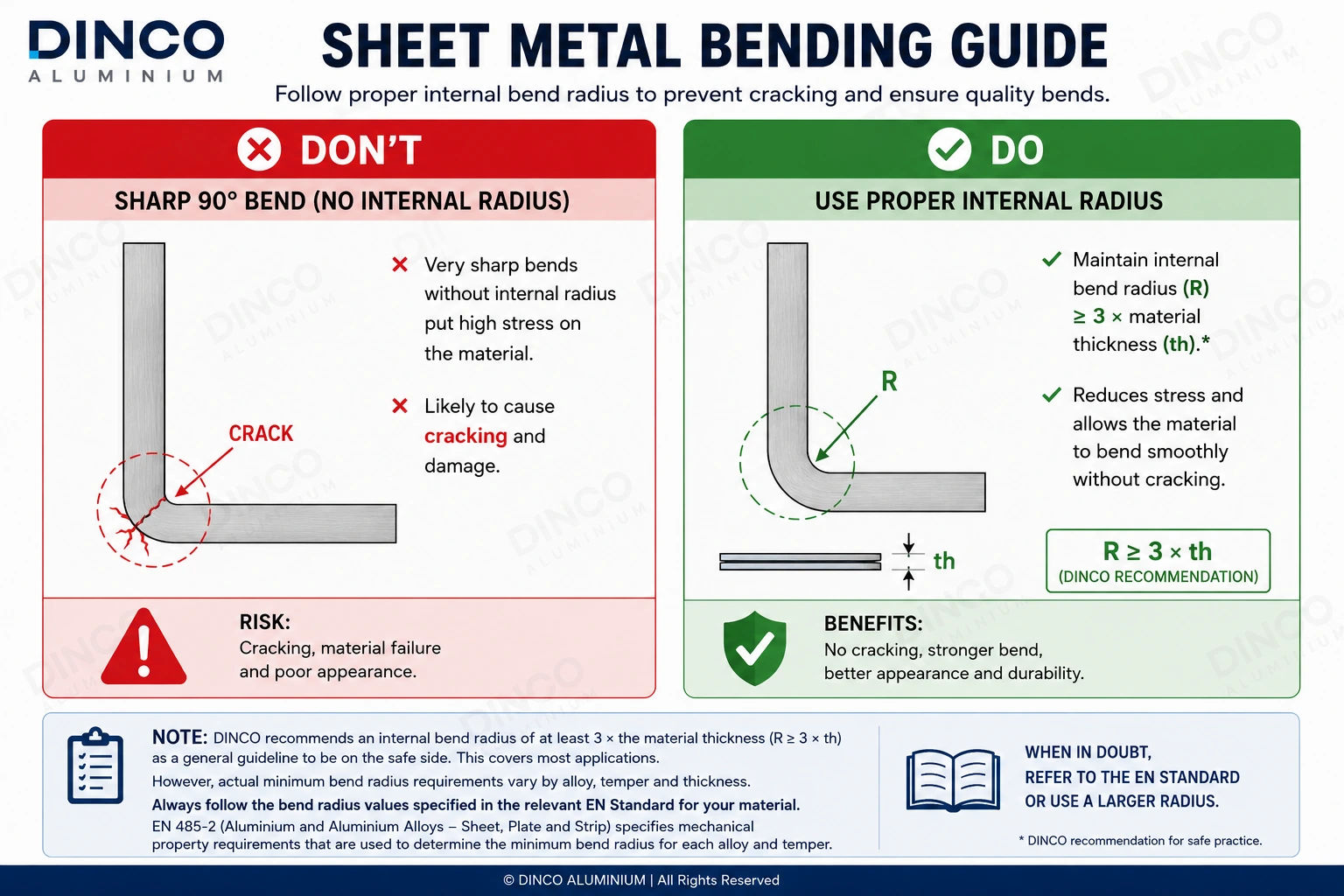
Forming sheet metal into precise shapes requires a balance between machine force and metal ductility. Press brake operators often force sharp inside corners on sheet metal to create tight visual lines. But pressing a punch too deep creates micro fractures along the bend line. This turns good metal sheets into wasted scrap. At Dinco Trading LLC, we work directly with machine shops, facade fabricators, and HVAC manufacturers across Dubai, Sharjah, and Abu Dhabi. We see firsthand how understanding the minimum internal bend radius prevents costly project delays. Here is a practical engineering guide on why minimum internal bend radius matters and how to set it right on your workshop floor.
Minimum internal bend radius is the smallest inside arc radius you can form on a sheet metal piece without cracking the outer surface or weakening the metal structure. It is expressed as a ratio of the inside radius to the total sheet thickness.
Several physical factors control how tight you can bend an aluminium sheet on a press brake:
Ductile metals bend around tighter corners. Pure aluminium like AA 1100-O can take a tight zero radius bend without cracking. Work hardened alloys like AA 3003-H14 or AA 5052-H32 require an inside bend radius equal to 1.0 to 1.5 times the sheet thickness. Fully hardened structural alloys like AA 6061-T6 need up to 3.0 times the sheet thickness.
Rolling mills stretch metal grains parallel to the rolling direction. Bending metal parallel to these grain lines increases the risk of cracking along the seam. Always position major bend lines perpendicular across the grain direction, or at least at a 45 degree angle, to maximize flex resistance.
Using a punch tip that is smaller than the natural minimum radius causes crease lines. The punch gouges into the inner surface rather than smoothly bending the metal across the lower V-die opening.
| Alloy Grade & Temper | Elongation Limit (%) | Recommended Minimum Radius (r / t) | Typical Workshop Use |
|---|---|---|---|
| AA 1100 - O | 25 - 35% | 0.0 t to 0.5 t | Deep forming, soft flashing trims |
| AA 3003 - H14 | 8 - 12% | 1.0 t to 1.5 t | HVAC ducts, roofing sheets, panels |
| AA 5005 - H14 (55HX) | 6 - 10% | 1.0 t to 1.5 t | Anodized facade cassettes, trims |
| AA 5052 - H32 | 7 - 12% | 1.5 t to 2.0 t | Coastal cladding, vehicle enclosures |
| AA 6061 - T6 | 8 - 10% | 2.5 t to 3.5 t | Structural brackets, heavy supports |
Ignoring proper bend radius specs triggers immediate physical failures that waste shop time and money:
Follow this simple checklist before running production batches on your press brake:
At Dinco Trading LLC, we supply high grade, bend compliant aluminium sheets and plates to fabricators across Mussafah, Al Quoz, and Sharjah Industrial Area. We carry extensive stocks of AA 1100, AA 3003, AA 5005, AA 5052, and AA 6061 with certified mechanical properties and Mill Test Certificates. Our technical team helps you pick the right alloy grade and temper for your exact bending tools, ensuring crack free results on every project. Reach out to us today for reliable material advice, fast local delivery, and competitive pricing.
With multiple warehouse locations in Abu Dhabi, Dubai & Sharjah, we ensure speedy deliveries to our customers all across the uae
